
In the realm of artificial intelligence (AI), the training of models is a computationally intensive process that involves handling vast amounts of data and performing numerous calculations. As AI models grow in complexity and scale, the efficiency of this training process becomes a critical factor. One of the significant challenges that affect this efficiency is the “memory wall.” Understanding the memory wall and its implications is crucial for developing strategies to optimize AI training.
What is the Memory Wall?
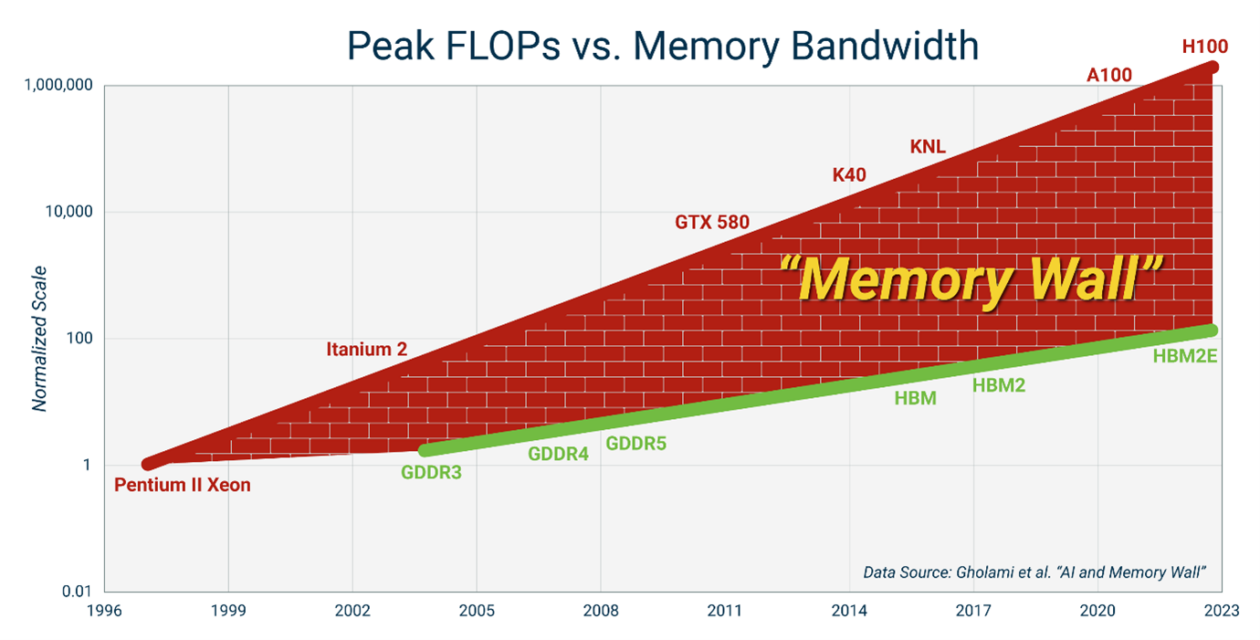
The term “memory wall” refers to the growing disparity between the speed of a computer’s CPU (central processing unit) and the speed at which it can access data from memory. Over the years, CPU speeds have increased dramatically due to advances in semiconductor technology. However, memory speeds have not kept pace with this increase, leading to a bottleneck where the CPU spends more time waiting for data from memory than performing actual computations. This latency in memory access can significantly hamper the performance of computational tasks, including AI training.
The term “memory wall” was coined to describe a significant and growing bottleneck in computer architecture. This bottleneck arises from the disparity between the rapid improvements in CPU speeds and the relatively slower advancements in memory speeds. Here’s a detailed explanation of why it’s called the “memory wall”:
Historical Context and the Origin of the Term
In the early days of computing, both CPU and memory speeds were improving at comparable rates. However, as semiconductor technology advanced, the performance of CPUs began to accelerate much faster than memory technology. By the 1980s and 1990s, this discrepancy became increasingly noticeable. While CPUs could process instructions in nanoseconds, memory access times were lagging behind, measured in tens or hundreds of nanoseconds.
The term “memory wall” was popularized by a paper published in 1994 by William Wulf and Sally McKee titled “Hitting the Memory Wall: Implications of the Obvious.” The authors highlighted the growing performance gap between CPU speeds and memory access times, warning that this disparity could become a critical bottleneck in computing performance.
Why “Wall”?
The metaphor of a “wall” effectively captures the nature of this problem:
- Impediment to Progress: Just like a physical wall, the memory wall represents a formidable barrier that impedes the progress of overall system performance. Despite advancements in CPU technology, the benefits are significantly limited by memory speeds. This limitation creates a situation where the CPU is frequently waiting for data, unable to utilize its full processing potential.
- Sudden Obstruction: The wall metaphor also implies a sudden and significant obstruction. As CPUs became exponentially faster, the relative stagnation of memory speed created an abrupt and noticeable bottleneck. This sharp contrast can be visualized as hitting a wall, where further improvements in CPU speed offer diminishing returns due to memory access delays.
- Challenge to Overcome: The memory wall signifies a challenge that needs to be overcome for future progress. Just as scaling a wall requires effort and innovation, addressing the memory wall necessitates new approaches in computer architecture, memory technology, and system design.
Visualizing the Memory Wall
To illustrate, consider the following analogy: Imagine you have a high-speed sports car (representing the CPU) that can travel extremely fast. However, this car is constrained by a narrow, winding road with frequent stop signs (representing memory access). No matter how fast the car can go, its speed is limited by the road and stop signs. The road and stop signs symbolize the memory wall, a limiting factor that prevents the car from achieving its full speed potential.
The Impact of the Memory Wall on AI Training
1. Data Access Latency
AI training models require frequent access to large datasets stored in memory. For instance, consider training a convolutional neural network (CNN) on a large image dataset like ImageNet. Each image must be loaded from memory, processed, and then updated with the latest parameters. When the memory cannot supply data as quickly as the CPU or GPU can process it, the training process experiences delays. These delays accumulate over time, reducing the overall efficiency of the training. In large-scale AI models, where millions or even billions of parameters need to be updated iteratively, the impact of memory latency becomes even more pronounced.
2. Increased Energy Consumption
The inefficiency caused by the memory wall leads to increased energy consumption. For example, training a natural language processing (NLP) model like GPT-3 involves billions of parameters and requires significant computational power. When the CPU waits for data, it still consumes power, resulting in wasted energy. For large-scale AI training, which often runs on high-performance computing clusters or data centers, this inefficiency translates to higher operational costs and a larger carbon footprint. Energy-efficient training is not only a technical goal but also an environmental necessity.
3. Limited Scalability
Scalability is a key goal in AI model development. As models become more complex, they require more memory to store and process data. The memory wall imposes a limit on how effectively these models can scale. Even with powerful CPUs and GPUs, the bottleneck in memory access can restrict the performance gains from adding more computational resources. For instance, deploying a more advanced autonomous vehicle AI system that requires real-time data processing and decision-making can be hindered by memory access limitations, affecting both the speed of training and the feasibility of deploying larger models.
Strategies to Mitigate the Memory Wall
1. Memory Hierarchies and Caching
Implementing advanced memory hierarchies and caching mechanisms can help mitigate the memory wall. By using a multi-level cache system, data that is frequently accessed can be stored closer to the CPU, reducing the latency involved in fetching it from main memory. Modern processors already utilize several levels of cache (L1, L2, L3), and optimizing these caches for AI workloads can improve training efficiency. For instance, in training reinforcement learning models for game AI, optimizing memory access through caching can lead to faster iterations and improved model performance.
2. High-Bandwidth Memory (HBM)
High-Bandwidth Memory (HBM) is a type of RAM designed to provide higher bandwidth and lower power consumption compared to traditional memory. HBM achieves this by stacking memory chips vertically, allowing for wider data paths and faster data transfer rates. Integrating HBM in AI training systems can help bridge the gap between CPU/GPU speeds and memory access times, alleviating some of the memory wall’s impact. This technology is particularly beneficial in scenarios like training deep learning models for medical imaging, where large volumes of high-resolution images need to be processed quickly.
3. Parallel Processing and Distributed Computing
Leveraging parallel processing and distributed computing frameworks can also address the challenges posed by the memory wall. By distributing the training workload across multiple processors or even multiple machines, the memory bandwidth requirement per processor is reduced. Technologies such as TensorFlow and PyTorch support distributed training, allowing for more efficient utilization of computational resources and memory. This approach is widely used in industries like finance, where complex models are trained to predict market trends and require significant computational power.
4. Specialized AI Hardware
The development of specialized AI hardware, such as Google’s Tensor Processing Units (TPUs) and custom AI chips from other companies, is another approach to overcoming the memory wall. These specialized processors are designed with AI workloads in mind, optimizing memory access patterns and providing higher bandwidth memory solutions. As a result, they can offer significant performance improvements for large-scale AI training tasks. For instance, TPUs are used in Google’s data centers to train large-scale machine learning models for applications like natural language translation and image recognition.
Conclusion
The memory wall presents a significant challenge in scaling AI training models efficiently. As the demand for more complex and capable AI models continues to grow, addressing the memory wall becomes increasingly important. Through a combination of advanced memory hierarchies, high-bandwidth memory, parallel processing, distributed computing, and specialized AI hardware, the impact of the memory wall can be mitigated. By implementing these strategies, researchers and practitioners can improve the efficiency of AI training, enabling the development of more powerful and scalable AI systems.
Understanding and addressing the memory wall is crucial for the future of AI, as it directly influences the ability to train more advanced models in a cost-effective and energy-efficient manner. As technology evolves, continuous innovation in memory architecture and computational strategies will be essential to overcome this persistent challenge.